Feather Turning in Space - George Morrison Mural
About the mural
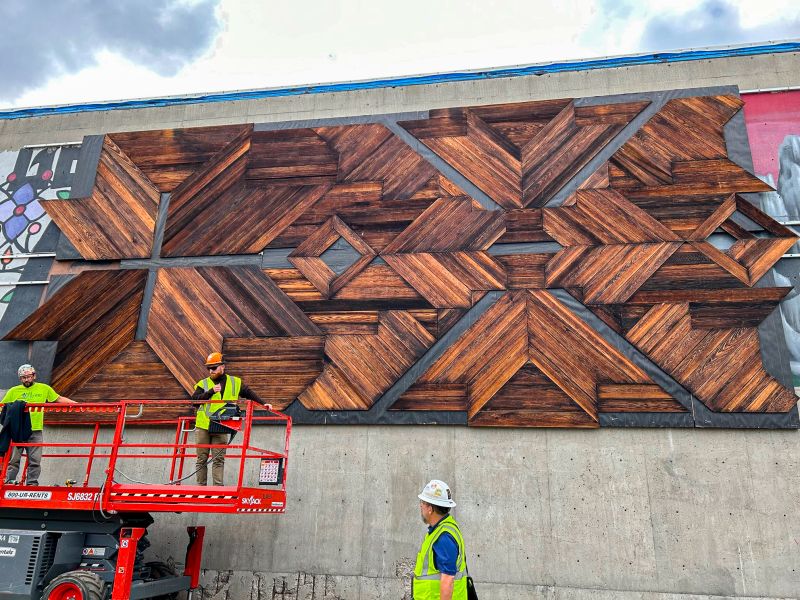
In 1974-75, George Morrison (Grand Portage Ojibwe) created a mural, based on a feather turning in space, for the Minneapolis American Indian Center. This mural is formed from interlocking chevrons of cedar that seem to move, forming three dimensional images, changing from every visual angle. He called his work “painting in wood.”
The mural’s home is outside so that it can be accessible to everyone. Restoration work was done on the piece during the center’s renovation and expansion in 2022-2024. The mural was carefully taken apart and sent to Montana, where each piece was cleaned and restored. The mural was then reinstalled on the eastern exterior wall of the center, so that it can continue being a destination for years to come. The restoration work was supported by a generous anonymous $30,000 donation.
About the artist
George Morrison—artist, intellectual, activist, modernist—was born in 1919 in Chippewa City, Minnesota, near his beloved Gichi-gami, Lake Superior. He was the son of Jim and Barbara Mesaba Morrison and enrolled as Grand Portage Ojibwe. As a child he was hospitalized in St. Paul with tuberculosis. He discovered his proficiency as an artist early and went on to study at what is now Minneapolis College of Art and Design. In New York City he explored Abstract Expression, ultimately becoming a master who used his passionate connection to the world of water and light to create a powerful universe of his own. He returned to teach at the University of Minnesota, married a fellow artist, Hazel Belvo, forming a unique creative bond. Morrison also reconnected with his Grand Portage community and deepened his ties to the waterscape that would inspire some of his greatest works, including the mural for the Minneapolis American Indian Center. A decade after completing this extraordinary work, George Morrison was diagnosed with a grave lymphatic illness and, in a ceremony conducted by Walter Caribou, a Grand Portage Ojibwe knowledge keeper who spoke mostly Anishinaabemowin, he received two spiritual names, Waawaategwanegaabaw, Standing in the Northern Lights, and Gwekigwanegaabaw, Turning the Feather Around, a name prefigured in this mural. George Morrison understood that everything connected in the transcendent expression of his art. He said that his life and art were based on “the power of the rock, the magic of the water, the religion of the tree, the color of the wind, and the enigma of the horizon.”
– Written by Louise Erdrich, Pulitzer Prize and National Award-winning author. Proud member of the Turtle Mountain Band of Chippewa.